Guidelines for the development of a critical software under emergency
During the COVID-19 pandemic, around the middle of March 2020, we have been developing a simplified mechanical lung ventilator, called MVM (Mechanical Ventilator Milano), to answer the high request of ventilators for Acute Respiratory Distress Syndrome (ARDS) in intensive care units. The ventilator is now produced and certified for use in the EU, USA, and Canada. In this experience, which - software side - involved more than 100 volunteer researchers towards software certification at the extreme of their strength, we collected a set of lessons learned. From this experience, we have synthesised a set of guidelines that might help similar projects in the future.
In this page we collect all the material used in order to produce guiedlines for the development of a critical software under emergency:
- Lessons learned from the MVM project which have been proposed in our previous work: A. Bombarda et al., “Lessons Learned from the Development of a Mechanical Ventilator for COVID-19,” 2021 IEEE 32nd International Symposium on Software Reliability Engineering (ISSRE), 2021, pp. 24-35, doi: 10.1109/ISSRE52982.2021.00016
- Validation of lessons learned executed in the context of two courses for the Italian engineering society.
- Guidelines
- Validation of guidelines via questionnaires and interviews
Lessons Learned
| Lessson learned | Description |
|---|---|
| LL.1.1 IEC 62304 and V-Model | The development process was strongly influenced by the IEC 62304 standard, so the V-model, although not mandated, is the “best fit” with regulatory requirements as it produces the necessary deliverables required when seeking regulatory approval. |
| LL.1.2 Use of agile practices | However, it was necessary to integrate the V-model with agile practices, to combine efficiency, quality, maintainability, and flexibility. |
| LL.2.1 Coordination effort | The project was successful but there was a quite huge overhead of coordination, with various calls every day from the morning till evening. The coordination of the team should not be underestimated. Open-source software development could be a good development experience from which projects of this nature can learn. |
| LL.2.2 Enlarging team | Adding people is not necessarily a good solution to improve the efficiency and effectiveness of a team. |
| LL.2.3 Commitment and participation | Having responsibility for each sub-activity and setting strict intermediate goals have favoured commitment and participation. |
| LL.3.1 Multiplicity of tools | The use of a great variety of tools (one tool for each particular purpose) even if not integrated and not specific for software project management, has provided indispensable support to the team. |
| LL.3.2 Templates and review process | Having a partner that provided the templates and a clear review process has helped to define which activities should be performed. |
| LL.3.3 Use of UML | Standard graphical notations like UML shown to improve communication and to be easily usable by non-software experts (very skilled in other fields, though). |
| LL.4.1 Written requirements | Not having written requirements since the beginning led to having various attempts to address the requirements in different software components. For this reason, precise system requirements are very important also in an emergency situation. Having developers referring to the same written documents without inconsistencies reduces the development time. |
| LL.4.2 Reverse engineering | For systems for which a prototype is present, especially if it is developed by domain experts, reverse engineering has shown to be a viable solution for discovering functionalities and configuration parameters to be included in system requirements. |
| LL.4.3 Need of a traceability system | A traceability system helps developers to trace all the requirements and their changes through all the development process. |
| LL.5.1 Upfront aspects balancing | As we can learn from software architecting, it is important to go towards “just-in-time architecture” and to find a balance between upfront aspects (what is planned before the start of development) and emerging aspects (what appears as decisions are taken in the course of the development, e.g. by fixing wrong assumptions or making decision deliberately postponed). |
| LL.5.2 Importance of the architecture | Software architecture is still important even during emergency development. In fact, we have experimented that without a well-defined architecture (as for the prototype), it was not clear how software components were supposed to synchronize and exchange information among them. |
| LL.6.1 Safety assurance effort | Isolating safety-critical features, by organizing the system in different components, has allowed us to focus the safety assurance effort on a limited portion of the system. |
| LL.7.1 Modularity and parallelization | Designing a product in a modular way has been a successful decision, since, in a distributed project (such as the one of the MVM) it has allowed different teams to work in parallel on different parts of the system. |
| LL.7.2 State machines for wide inter-pretability | We have found that using state machines, for the specification and the design, has contributed to favor the discussion on the adopted solutions even with people not used to software development since graphical representations are easily understandable. |
| LL.8.1 Mix of programming languages | Using several programming languages in a single project is usually discouraged [26]. However, in an emergency (such as during COVID-19) in which the products have to be delivered as soon as possible, we have experienced that having more languages allows the inclusion of more developers and speeds up the implementation process, with only a minimal effort in integration of the code. |
| LL.8.2 Coding standards and guidelines | Sharing the coding standards and guidelines (e.g., the importance of comments) with all the people involved in the implementation phase is of key importance, in particular with heterogeneous development groups, even during emergency development. |
| LL.8.3 Advantages of state machines in implementation | State machines added flexibility and maintainability since it was very simple to modify it and then regenerate code, which was directly integrated, through a wrapper, to the hand-written code. |
| LL.9.1 Testing not only safety-critical components | Defining in advance the safety classes of all the components in the developed system can significantly facilitate the testing activities. In fact, medical software safety standards do not mandate extensive unit testing for class A components. Thus, a good practice is to design the system in a modular way, isolating all the non-dangerous functions (i.e., in class A) that testers can limitedly check. |
| LL.9.2 Importance of testing | Besides what is required by the standards, testing activities are important when performed for safety-critical components. This is not an obvious aspect in heterogeneous aspects. |
| LL.9.3 Advantages of CI tools in community projects | As MVM has been a community project, where a lot of people have worked at the same time on the same system, CI tools have proved to be crucial for maintaining under control the modifications made by all the developers. |
| LL.10.1 Integration testing for SIMDs | It is challenging to develop and validate systems that integrate hardware, software, and mechanics by distributed teams. Often, real hardware is needed for testing the software that is affected or affecting a piece of hardware. Software-in-the-loop simulation requires a special setting with professional simulation tools and an accurate hardware model, which is not always available and reliable. |
Validation of lessons learned
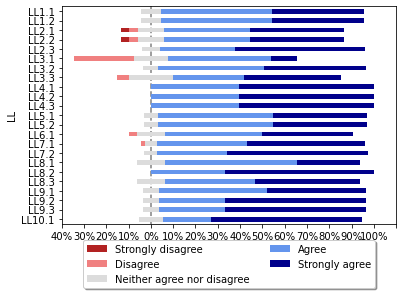
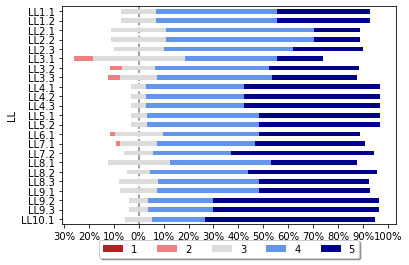
For each lesson learned we have asked:
- How do you agree or disagree with the lesson learned?
- Possible answers: Strongly Agree - Agree - Neither agree nor disagree (I don’t mind these things) - Disagree - Strongly Disagree
- In your opinion, how important is the lesson learned?
- Possible answers: 1 (not at all important) - 2 - 3 - 4 - 5 (very important)
The obtained results are summurized in the following graphs:
Guidelines
| Guideline | Description | Rationale |
|---|---|---|
| GL1 Plan-driven/predictive and agile integration | Integrate plan-driven/predictive processes with agile practices, to combine rigorousness with efficiency and flexibility. | The idea is to benefit from the good characteristics of predictive and agile processes. |
| GL2 Review process | Define a clear review process to identify the activities that should be performed. | It is important to clearly define the review process to speed up the development. |
| GL3 Documentation templates | Reuse and/or adapt existing templates, when available, for producing the documentation required by certification standards and processes, otherwise produce precise templates to be adopted by the entire project. | To speed up the development while guaranteeing quality, it is important to have precise templates; better if there are already established templates that can be reused. |
| GL4 Competencies, resources and commitment initial estimation | Estimate competencies, resources, and commitment of the various team members in the initial phases of the project since potential new members should be added in this initial phase. | Despite the emergency, it is important to invest some time on this upfront activity in the startup phase. |
| GL5 Definition of coordination team and the coordination plan | Define the coordination team and the coordination plan of the team upfront and in the startup phase. | The coordination team needs to be ready to work and there should be clear indications to the development teams. |
| GL6 Responsibilities assignment | Assign precise and stable responsibilities to the members of the coordination team. | The coordination team should be as stable as possible to avoid delays that can easily propagate to the development teams. |
| GL7 Flexible development teams | Development teams can be created according to the needs during development and members should be prepared to help in various tasks according to their availability and competencies. In every iteration or sprint, team members can be assigned to different tasks. | Development teams should work agile and change should be the norm rather than the exception. |
| GL8 Inter-team coordination and communication | Define the communication and coordination instruments, tools, and protocols for inter-team coordination. | There is the need for clear and stable instruments, tools, and protocols for the communication and coordination among different teams. |
| GL9 Intra-team coordination and communication | Delegate to the development team members the selection of instruments and tools for development and intra-team coordination and communication. | Within development teams, members should be able to select the development, communication, and coordination instruments and tools they like. |
| GL10 Define a traceability system | Define upfront and in the startup phase a traceability system for the entire development. | Traceability is of key importance in the development of safety-critical systems, then, from the initial phases of the project, there is the need of a traceability system fro the entire development. |
| GL11 Use visual and graphical notations | Use, when possible, visual, graphical, and easy-to-understand notations, e.g. UML, for communication among team members with heterogeneous expertise and competencies. | Graphical notations might facilitate the communication among team members with different background and knowledge. |
| GL12 Write precise requirements and reverse engineering | Write precise system requirements also in an emergency situation. If a prototype exists, use reverse engineering to extract useful information. | Requirements are important to guide the development and the validation phase. |
| GL13 Define an architecture upfront | Define an architecture upfront to allow different teams to work in parallel on different parts of the system and to facilitate integration. | A clear identification of components and interfaces might help development teams to work independently and in parallel. |
| GL14 Limit the upfront architecture to stable decisions | Limit the upfront architecture to stable decisions, while paying attention to concerns that matter across team borders. | An architecture description can be considered a boundary object between multiple cross-functional teams: it can be used to create a common understanding across sites while preserving each team’s identity. |
| GL15 Update the architecture | Integrate system architects into teams to capture emerging aspects during development and update the architecture accordingly. | Since the upfront architecture should be limited to stable aspects, architects, or those team members playing the role of architects and taking architectural decisions, should capture emerging aspects during development and update the architecture accordingly. |
| GL16 Exploit communities of practices | Exploit communities of practices to reason about changes that impact the architecture, and to assess and validate architectural decisions. | In order to reduce assumptions that can become inconsistencies, it is important to carefully assess decisions before setting them into stone. Community of practices is a good instrument for enabling architects to reason about changes. |
| GL17 Isolate safety-critical parts | Isolate safety-critical features in specific components or modules to focus the safety assurance effort on a limited portion of the system. | Safety standards often require different levels of attention and different validation activities. The isolation of safety-critical features in specific components or modulespermits to limit the validation and certification activities. |
| GL18 Use state machines in specifications | Use state machines to specify modes and mode’s transitions in the requirement specification. | State machines are used in various domains and are a good instrument to easily communicate complex behaviors. |
| GL19 Use state machines for code generation | Use, when possible, executable state machines for specifying the main functional logic and the critical part of the system, and, then, generate code from the state machines. | The use of executable state machines promotes modifiability, maintainability, and understandability. |
| GL20 Different programming languages | Allow the use of different programming languages to facilitate the inclusion of heterogeneous developers and speed up the implementation process, when this does not create integration problems. | When the use of different programming languages is not creating integration problems, e.g. when code produced with different languages is deployed on different machines, it would be beneficial to allow development teams to use languages they are familiar with. |
| GL21 Coding standards and guidelines | Adopt coding standards and guidelines from the beginning. | Coding standards are often required by safety standards and in general they promote quality of the code. |
| GL22 Continuous integration and unit testing | Use CI tools and automated unit testing in order to continuously integrate the contributions of the various teams, to keep and promote quality, and to maintain under control the modifications made by all the developers. | CI tools and automatic testing instruments enable various teams to work in parallel without breaking the code, and permit to avoid the big bang integration problem. |
| GL23 Focus on testing activities | While guaranteeing the quality for the whole system, focus the testing activities to safetycritical components as required by the standard. | Safety critical components are those that require major attention. The parts of the system that are not critical can follow classic quality management recommendations. |
| GL24 Role of emulators | When possible, use simulators and/or emulators, but plan for an integration, system, and acceptance testing phase. | Simulators and emulators can speed up the development and validation, but they are often limited and integration, system, and acceptance testing is unavoidable. |
Validation of guidelines
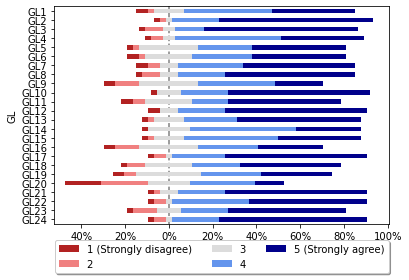
For each lesson learned we have asked:
- How do you agree or disagree with this guideline?
- Possible answers: 5 (Strongly Agree) - 4 - 3 - 2 - 1 (Strongly Disagree)
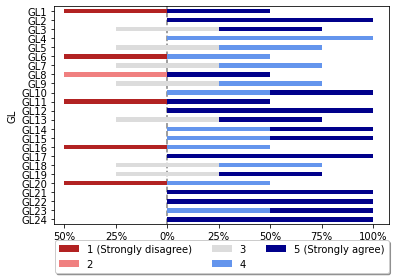
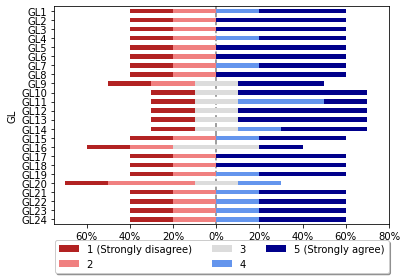
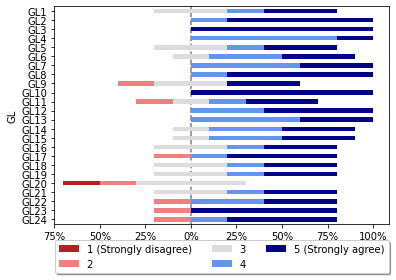
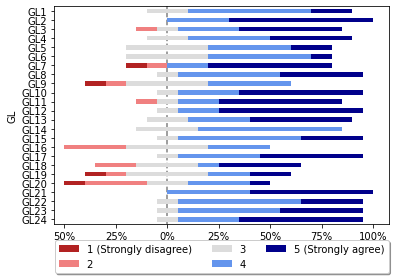
We have created identical copies of the questionnaire and distributed to various groups of experts:
- experts in agile and safety-critical systems,
- experts in non-agile safety-critical systems,
- experts in health care safety-critical systems,
- experts in safety-critical systems in other domains, mostly automotive,
- experts involved in the development of the MVM,
- developers of other ventilators under emergency.
All the answers are available here
The obtained results are summurized in the following graph:
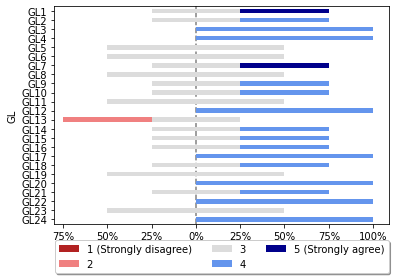
In the following, we show for each questionnaire the graph summarizing all the answers.
- Experts in agile and safety-critical systems
- Experts in non-agile safety-critical systems
- Experts in health care safety-critical systems
- Experts in safety-critical systems in other domains, mostly automotive
- Experts involved in the development of the MVM
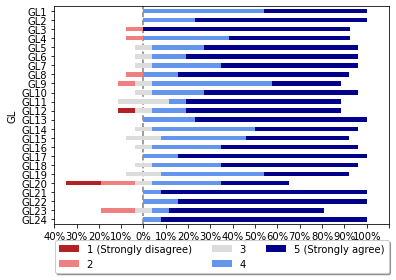
- Developers of other ventilators under emergency